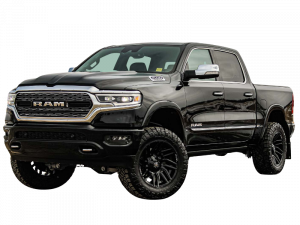
A properly equipped 2026 RAM 1500 carries up to 2,360 lb (1,071 kg) of payload (RAM Canada, 2026). Payload is everything the truck holds rather than pulls: passengers, fuel, tools, accessories, and the tongue weight pressing down from a trailer.
Here’s the catch, and it is the whole reason this guide exists. That 2,360 lb belongs to one deliberately light configuration. Add a crew cab, four-wheel drive, a sunroof, leather and a running-board package, and the truck that shows up in your driveway carries meaningfully less. Worse, most buyers never check, because payload is the one capability figure that almost never comes up on a test drive.
So this guide covers what payload means on a half-ton, how RAM arrives at the number, which levers move it, and where the only figure that actually governs your truck is printed.
Key Takeaways
- The 2026 RAM 1500 carries up to 2,360 lb (1,071 kg) of payload when properly equipped (RAM Canada, 2026). That is a ceiling for a light configuration, not a promise for yours.
- Payload equals gross vehicle weight rating minus base weight, so every factory option you add subtracts from it, pound for pound (RAM Canada, 2026).
- The most powerful engine carries the least. The 540 hp High-Output Hurricane is rated at 1,510 lb (685 kg), below even the base 3.6L Pentastar V6 at 1,790 lb (812 kg) (RAM Canada, 2026).
- Tongue weight is payload. RAM calculates conventional tongue weight at 10 percent of gross trailer weight, and every pound of it lands on your truck before the first passenger does.
What Does Payload Actually Mean on a RAM 1500?
Payload is gross vehicle weight rating minus what the truck already weighs, and RAM states the formula plainly in its published payload and towing material: payload equals GVWR minus base weight (RAM Canada, 2026). On the 2026 RAM 1500 that arithmetic leaves up to 2,360 lb (1,071 kg) at the very top of the range.
Read that definition slowly, because the phrase “base weight” is doing a lot of work. RAM calculates from a base configuration, not from the truck you ordered. Options are not part of base weight, so they do not reduce the published maximum. They absolutely reduce yours.
That is the single most misunderstood thing about half-ton payload. Towing ratings get scrutinised, badges get compared, and then a buyer loads five people and a box of gear into a well-equipped crew cab and quietly runs out of truck. Nothing warns you. There’s no gauge for it.
One more definition worth having early: payload and trailer weight ratings are calculated separately and are not additive. Maxing out one does not leave the other intact. If you want the trailer side of that story, our guide to how much a 2026 RAM 1500 can tow handles it in full, and this article stays on what rides in the truck.
How Much Payload Does Each 2026 RAM 1500 Engine Carry?
The standard-output 3.0L Hurricane carries the most at 1,840 lb (835 kg), the 3.6L Pentastar V6 follows at 1,790 lb (812 kg), and the 540-horsepower High-Output Hurricane carries the least at 1,510 lb (685 kg) (RAM Canada, 2026). The most powerful engine in the lineup is the weakest on payload, by a wide margin.
| Engine | Horsepower | Torque | Max payload |
|---|---|---|---|
| 3.0L Hurricane twin-turbo I6 (Standard Output) | 420 hp | 469 lb-ft | 1,840 lb (835 kg) |
| 3.6L Pentastar V6 with eTorque | 305 hp | 269 lb-ft | 1,790 lb (812 kg) |
| 3.0L Hurricane twin-turbo I6 (High Output) | 540 hp | 521 lb-ft | 1,510 lb (685 kg) |
| 5.7L HEMI V8 | 395 hp | 410 lb-ft | Not published per engine |
Look at the gap between the top and bottom rows: 330 lb (150 kg) separates the two versions of the same 3.0L engine. The base V6 out-carries the High Output by 280 lb (127 kg). If your truck’s job is weight in the box rather than acceleration, the horsepower column is close to irrelevant.
Why does that happen? The High Output is packaged into heavier, better-equipped trims, and a heavier truck has less room under its GVWR. Same physics, different starting point. Buyers weighing the two engines on character rather than capacity will find our RAM 1500 HEMI vs Hurricane comparison more useful than this table.
There is also an honest discrepancy worth naming. RAM Canada’s headline maximum for the lineup is 2,360 lb (1,071 kg), while the per-engine grid on the same page tops out at 1,840 lb (835 kg). That’s a 520 lb (236 kg) spread between two figures published by the same manufacturer, and it exists because the two describe different configuration bases. RAM does not spell out the build behind the 2,360 lb rating, so we won’t guess at it either.
Why Does a Loaded Trim Carry Less Than a Base Work Truck?
Every pound the factory bolts on is a pound you can no longer carry, which is why a fully optioned truck carries less than a plain one. RAM’s own disclaimer puts it in writing: additional options, equipment, passengers and cargo weight may affect payload weights (RAM Canada, 2026). Five levers move the number.
Cab. A crew cab is a bigger, heavier structure than a quad cab, with more glass, more seat, more sound deadening and two more doors. It buys you room for people. It costs you payload.
Box length. A longer box adds structure and weight behind the rear axle. It also adds usable space, so the trade is real in both directions rather than a straight loss.
Drivetrain. Four-wheel drive brings a transfer case, a front differential, a front driveshaft and heavier hardware throughout. It is one of the larger single subtractions on a half-ton, and in Alberta almost nobody skips it.
Engine. Covered above, and the numbers do the arguing: 1,840 lb, 1,790 lb, 1,510 lb (RAM Canada, 2026).
Trim content. Panoramic roofs, powered running boards, larger wheels, ventilated leather seating, big audio systems and towing hardware each weigh something. Individually they look trivial. Together they are the reason a top trim can give up a noticeable share of a base truck’s capacity.
None of this makes a nicer truck a worse truck. It makes it a different truck, and the buyer who hauls has to know which one they’re signing for. Browse our new RAM 1500 inventory and we’ll pull ratings on any specific build.
Where Do You Find Your RAM 1500’s Real Payload Number?
Open the driver’s door and read the Tire and Loading Information label on the jamb. It gives a combined occupant and cargo weight calculated for that exact truck, with its cab, box, drivetrain and factory options already subtracted. That figure outranks every published maximum, including the 2,360 lb ceiling (RAM Canada, 2026).
The label is a white or yellow sticker on the B-pillar, roughly at shoulder height when the door is open. Alongside tire sizes and cold inflation pressures, it carries a line stating the combined weight of occupants and cargo that should never be exceeded, in kilograms and pounds. That’s your payload. Not the brochure’s.
Two things about it catch people out.
First, it counts occupants. Payload is not “what fits in the box,” it is everything above the truck’s own weight, and the label says so explicitly. Your passengers spend it.
Second, it reflects the truck as it left the factory. A hard tonneau, a spray-in liner, a headache rack, a bed slide, running boards, a winch bumper or a toolbox fitted afterward all consume payload, and none of them are subtracted from the printed figure. The sticker doesn’t update itself.
In our experience, walking two trucks on the lot and reading both placards takes about thirty seconds and reframes the whole conversation. Buyers who arrive certain they want the loaded truck sometimes leave with a mid-trim one, purely because they saw the difference written down.
What Eats Your Payload Before the Cargo Does?
Passengers and accessories usually claim the first several hundred pounds. Start from the standard-output Hurricane’s published 1,840 lb (835 kg) (RAM Canada, 2026), seat five adults at roughly 175 lb each, and about 875 lb (397 kg) is committed before anyone touches the tailgate. Slightly under half the budget, gone.
Now add the hardware most Alberta trucks wear. A spray-in liner, a hard tonneau, running boards and a crossbed toolbox can total a couple of hundred pounds between them depending on what you fit. Call it 200 lb as a working estimate and roughly 765 lb (347 kg) remains for whatever you actually came to haul.
That is a genuinely useful load. It is also a lot less than a full box looks like it should hold, which is why aggregate, wet firewood, patio stone and bagged concrete put half-tons over so reliably. Dense material fills the payload budget long before it fills the box. The truck gives you no warning at all: the suspension squats, the steering goes light, and most drivers read that as “loaded” rather than “over.”
If the pattern repeats every weekend rather than once a summer, that’s a capacity problem rather than a loading problem, and it is the point where a heavier truck starts making sense.
How Payload and Tongue Weight Share One Budget
Tongue weight is payload, not a separate allowance. RAM calculates conventional tongue weight at 10 percent of gross trailer weight in its published payload and towing charts, and 15 percent for a fifth-wheel or gooseneck pin (RAM Canada, 2026). Every one of those pounds lands on the same figure printed on your door jamb.
Run it. A 6,000 lb conventional trailer at RAM’s 10 percent basis puts 600 lb (272 kg) on the ball. RAM’s chart accounts for another 75 lb of conventional trailering equipment, so about 675 lb of payload is spent before a single person gets in. Against a truck rated 1,840 lb (835 kg), you have 1,165 lb (528 kg) left. Against a High-Output Hurricane rated 1,510 lb (685 kg), you have 835 lb (379 kg).
Real-world trailers often sit above RAM’s 10 percent calculation basis, commonly in the 10 to 15 percent range once the front bays and water tank are loaded, so treat 10 percent as the floor rather than the expectation. That convention comes from trailer and hitch practice generally, not from RAM.
Fifth-wheels are where this gets decisive, because pin weight is a much larger share of trailer weight and it lands directly in the box over the rear axle. Half-tons run out of payload there long before they run out of towing rating. When pin weight is the constraint rather than the trailer’s total weight, the answer is a heavier truck, and our breakdown of RAM 3500 payload, dually versus single rear wheel covers where that class of truck starts and why its ceiling reaches 7,590 lb (3,443 kg).
Payload Planning Through an Alberta Winter
Winter quietly adds weight to a truck that was already close to its limit. Nothing on the spec sheet accounts for it, and the season lasts long enough here to matter.
The list is short and it adds up: a set of winter tires on separate rims riding in the box for the swap trip, sand or a couple of bags of aggregate for ballast, a shovel, booster pack, tow strap, extra fuel and a bin of cold-weather gear. On a truck already carrying passengers and accessories, that’s real payload, and it’s the kind that lives in the box all season rather than coming out after the weekend.
Ballast deserves a specific note. Adding weight over the rear axle genuinely helps an empty half-ton find traction on packed snow, and it is worth doing. It is also payload, so it counts. Position it ahead of the tailgate and against the bulkhead rather than hanging off the back, keep it secured, and subtract it from what you have left for cargo.
The practical version of all this: weigh your truck loaded the way you actually drive it in February, not the way it sits empty in July.
Frequently Asked Questions
What is the payload capacity of a 2026 RAM 1500?
Up to 2,360 lb (1,071 kg) when properly equipped (RAM Canada, 2026). That maximum belongs to a specific light configuration, and RAM’s per-engine figures top out lower at 1,840 lb (835 kg). Your truck’s actual rating is printed on the driver’s door jamb label.
How is RAM 1500 payload calculated?
Payload equals gross vehicle weight rating minus the truck’s base weight (RAM Canada, 2026). Because RAM calculates from a base configuration, factory options are not deducted from the published maximum, but they are deducted from your truck. That is why the door jamb figure is usually lower than the brochure number.
Which 2026 RAM 1500 engine has the most payload?
The standard-output 3.0L Hurricane, at 1,840 lb (835 kg), followed by the 3.6L Pentastar V6 at 1,790 lb (812 kg) (RAM Canada, 2026). The 540-horsepower High-Output Hurricane is rated lowest at 1,510 lb (685 kg). RAM Canada does not publish a per-engine payload figure for the 5.7L HEMI V8.
Where is the payload sticker on a RAM 1500?
On the driver’s door jamb, on the B-pillar at roughly shoulder height. The Tire and Loading Information label lists tire sizes, cold inflation pressures, and a combined occupant and cargo weight that should not be exceeded. That combined figure is your truck’s real payload.
Does tongue weight count against RAM 1500 payload?
Yes, in full. RAM calculates conventional tongue weight at 10 percent of gross trailer weight and fifth-wheel or gooseneck pin weight at 15 percent (RAM Canada, 2026). A 6,000 lb trailer therefore commits roughly 600 lb (272 kg) of payload, plus the hitch hardware, before any passengers.
Why does my RAM 1500 have less payload than the advertised maximum?
Because the maximum describes a base configuration. A crew cab, four-wheel drive, a larger engine package and trim content such as a sunroof, leather seating and powered running boards all add weight that comes straight off your capacity. Accessories fitted after delivery reduce it further and are not reflected on the label.
Bring us the load you actually carry, and the people who ride with you, and we’ll match both to a specific build sheet instead of a brochure maximum. Browse the new RAM 1500 inventory, then come see us at Sherwood Dodge, 230 Provincial Ave, Sherwood Park, AB T8H 0E1, or call (780) 410-4100. We serve Sherwood Park, Edmonton, Strathcona County and Fort Saskatchewan, and we’re happy to open two door jambs side by side so you can read the difference yourself.