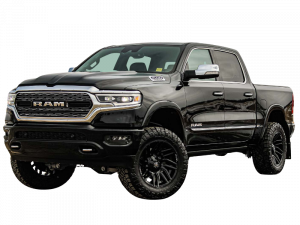
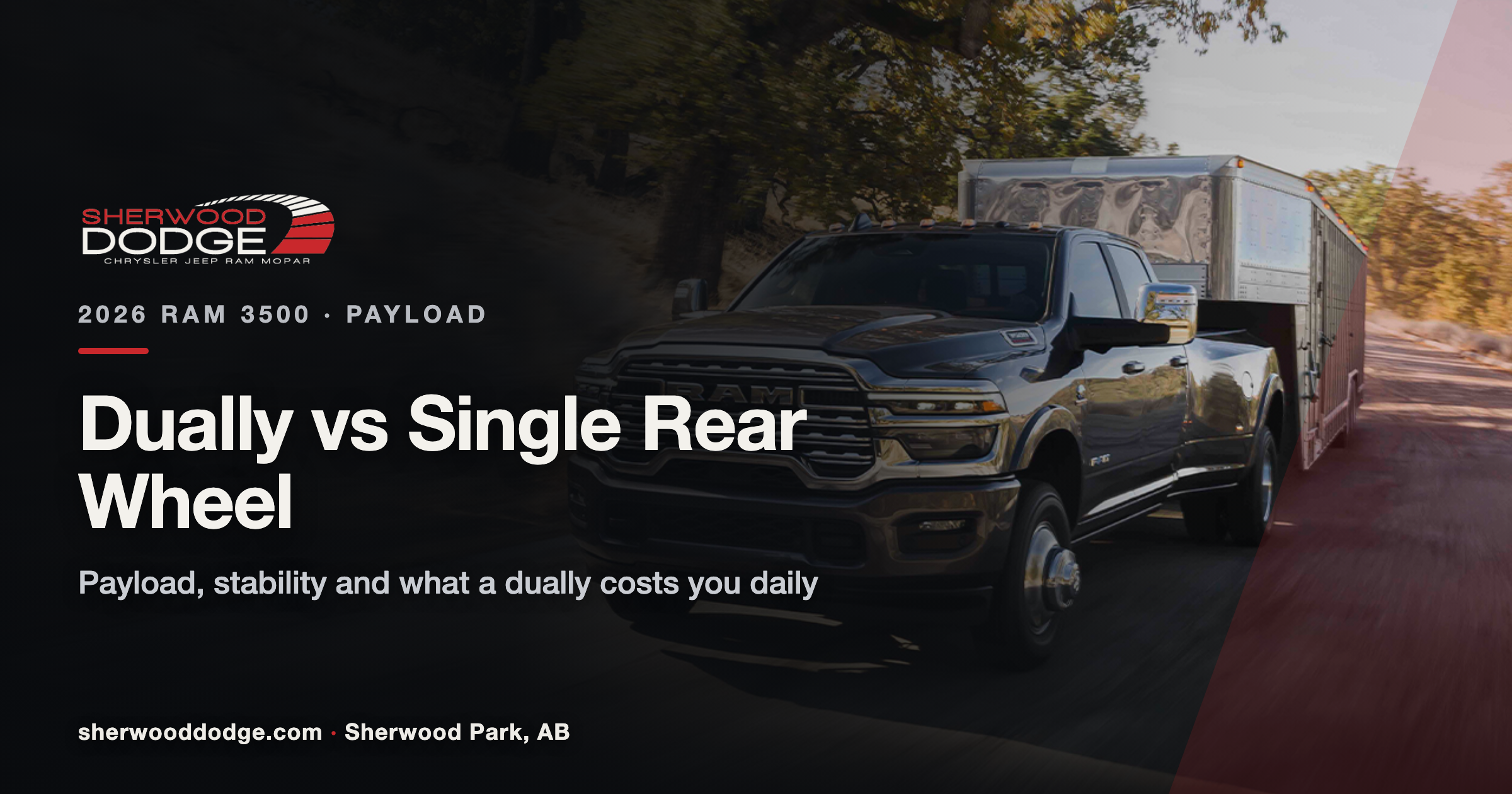
A properly equipped RAM 3500 carries up to 7,590 lb (3,443 kg) of payload, and that ceiling belongs to a dual-rear-wheel truck, so the dually is the right call the moment your fifth-wheel or gooseneck pin weight, plus passengers, fuel and gear, pushes a single-rear-wheel 3500 past its limit (RAM Canada, 2026). Towing gets the attention in truck ads, but payload is the number most one-ton buyers run out of first.
That is the honest framing we use on the lot in Sherwood Park: a RAM 3500 will out-tow almost any trailer a private buyer hooks up, but the pin weight of a heavy fifth-wheel or gooseneck is what quietly eats your capacity.
Key Takeaways
- Payload is the real limit. A RAM 3500 dually carries up to 7,590 lb (3,443 kg); a single-rear-wheel 3500 tops out at 4,970 lb (2,254 kg) with the same 6.4L HEMI V8 (RAM Canada, 2026).
- The highest-payload RAM 3500 is a gas truck. The Cummins High-Output dually carries up to 6,050 lb (2,745 kg), because the diesel powertrain weighs more (RAM Canada, 2026).
- Towing is where the dually separates hardest. Cummins dually: up to 36,610 lb (16,606 kg); single-rear-wheel: up to 26,080 lb (11,828 kg) (RAM Canada, 2026).
- A dually is six tires, not four, plus extra width and a firmer unloaded ride. Buy it for the load, not the look.
What Does Payload Actually Mean on a RAM 3500?
Payload is everything the truck carries, not just what looks like cargo: passengers, fuel, tools, accessories, the hitch hardware, and the downward pin or tongue weight your trailer puts on the bed. It is the gap between the truck’s gross vehicle weight rating and what the truck already weighs empty, so every option you add subtracts from it.
A crew of three, a full tank, a toolbox, a fifth-wheel hitch and a bit of gear can clear a thousand pounds before the trailer is connected. RAM Canada’s figures carry the qualifier that ratings are shown for a base configuration and that “additional options, equipment, passengers, and cargo weight may affect payload/towing weights” (RAM Canada, 2026). The advertised number is a ceiling for a stripped truck.
Pin weight surprises heavy-trailer buyers most: a fifth-wheel or gooseneck does not just pull behind you, it presses straight down into the bed over the rear axle, and that counts against payload pound for pound.
Still deciding between a three-quarter-ton and a one-ton? Start with our RAM 2500 vs RAM 3500 comparison, then come back here to choose your rear axle.
RAM 3500 Payload and Towing by Configuration
Here are the verified ceilings. The dually holds the top number in every category, and the gap is widest on payload and diesel towing.
| Spec | RAM 3500 single rear wheel | RAM 3500 dually (dual rear wheel) |
|---|---|---|
| Max payload, 6.4L HEMI gas V8 | 4,970 lb (2,254 kg) | 7,590 lb (3,445 kg) |
| Max payload, 6.7L Cummins High-Output | 4,400 lb (1,996 kg) | 6,050 lb (2,745 kg) |
| Max towing, 6.4L HEMI gas V8 | 17,730 lb (8,042 kg) | 18,150 lb (8,233 kg) |
| Max towing, 6.7L Cummins High-Output | 26,080 lb (11,828 kg) | 36,610 lb (16,606 kg) |
| Max GVWR | Up to 12,300 lb (5,579 kg) | 14,000 lb (6,350 kg) |
| Rear tires | Two, one per side | Four, two per side |
| Tires to replace | Four | Six |
| Best for | Daily driving, winter roads, tight yards, trailers well inside the limits | Heavy fifth-wheels and goosenecks, loaded flat decks, high pin weight |
Two things there deserve a second look. First, the highest-payload RAM 3500 is a gas truck: the Cummins is a heavier engine and that weight comes off the payload ceiling, which is why the HEMI dually carries roughly 1,500 lb more. If your job is weight in the bed rather than a huge trailer behind it, the gas truck may be the more capable choice, and our Cummins vs HEMI breakdown for Alberta owners goes deeper on that trade-off.
Second, 36,610 lb is a gooseneck rating. RAM’s maximum conventional hitch rating is 23,000 lb (10,433 kg), so a bumper-pull setup will never reach the headline number (Stellantis, 2025). Match the number to the hitch you use, and browse our new RAM 3500 inventory to see what is on the ground now.
What Does a Dually Actually Give You?
A dually gives you capacity and stability: the highest payload and towing ceilings in the lineup, a 14,000 lb (6,350 kg) GVWR, and four rear tires spreading the load instead of two (RAM Canada, 2026). Against a single-rear-wheel 3500 with the same engine, that is roughly 2,600 lb of extra payload on the HEMI and about 1,650 lb on the Cummins.
The stability half is what owners feel. Four rear tires put a wider footprint under the load, which makes a tall fifth-wheel far less nervous in a prairie crosswind or in the turbulence off a passing semi on Highway 16. A rear tire failure under load also leaves a tire still carrying that corner instead of a sudden loss of support on a heavily loaded axle.
What Does a Dually Cost You Day to Day?
A dually costs you width, parking ease, six tires instead of four, a firmer ride when the bed is empty, and some winter-road manners, which is why it is the wrong truck if you do not need its capacity. None of this shows up on a spec sheet, and all of it shows up in your driveway.
The rear fenders flare well outside the cab, and you feel it in a parkade, at a drive-thru, in a residential alley, and every time you thread through a tight yard site. Tires are next: six instead of four means a bigger job every replacement cycle, two extra pressures to track, and inner duals that are easy to let slide and expensive to ignore. Unloaded ride is the trade most buyers underestimate, because a one-ton is sprung for weight it is not carrying and the dually’s heavier-duty setup makes that ride firmer still.
Duallies on Alberta snow
A dually can feel less sure-footed than a single-rear-wheel truck on snow and ice when the bed is empty, and it is worth planning for. The rear weight spreads across four tires instead of two, so each presses down with less force, and the trailing inner tire runs in a track the outer one has already packed. Light rear end, more rubber, less bite.
This is practical guidance from experience and from what we hear from customers, not a manufacturer claim, and it is manageable: good winter tires on all six corners, sensible ballast when the box is empty, and a light throttle foot. But if your truck is empty all winter and loaded six weekends a year, an SRW 3500 is likely the better truck for the other forty-six.
How Do You Pick Based on Your Trailer’s Pin Weight?
Pick by arithmetic, not by feel: add your trailer’s loaded pin weight to your passengers, fuel, hitch and gear, and if that total exceeds the payload on your truck’s own door placard, you need more truck. That one calculation settles the dually question more reliably than any opinion on the lot.
Weigh the trailer loaded the way you actually travel, not the dry weight off the brochure, and get the real pin weight rather than estimating it. If the total lands comfortably under a single-rear-wheel 3500’s payload, buy the SRW and enjoy the narrower, better-riding truck. If it lands close to the limit or over it, buy the dually. Leave margin rather than shaving the last fifty pounds, because trailers get heavier over the years they are owned, rarely lighter.
One more item before you sign: because a dually carries a higher GVWR, registration, licensing and insurance treatment can differ depending on the weight and how you use the truck. Confirm where your specific setup lands rather than assuming, and our team serving Edmonton and Sherwood Park can point you to the right answer.
Where Do You Find Your Truck’s Real Payload Number?
Your truck’s actual payload is printed on the tire and loading information label in the driver’s door jamb, and it is the only payload figure that applies to your vehicle. Every advertised maximum belongs to a base configuration; the placard belongs to the truck in front of you, with its cab, bed, drivetrain and factory options already counted.
On most well-equipped trucks that number sits below the brochure maximum, because leather, a sunroof, four-wheel drive, a larger cab and a diesel engine all add weight that comes off the payload. Comparing two placards on the lot takes thirty seconds and tells you more than any spec sheet.
Which RAM 3500 Should You Buy?
Buy the single-rear-wheel RAM 3500 if your loaded pin weight and gear sit comfortably inside its payload, because it is narrower, easier to park, better riding and cheaper to keep in tires. Buy the dually when your numbers say you need the capacity.
- Heavy fifth-wheel, large gooseneck, or a loaded flat deck? The RAM 3500 dually, which with the Cummins tows up to 36,610 lb.
- Hauling weight in the bed more than dragging a trailer? The HEMI dually and its 7,590 lb payload ceiling.
- Truck mostly empty, occasional heavy tow? A single-rear-wheel 3500 is the better daily driver through an Alberta winter.
- Not sure? Bring your real loaded pin weight and we will match it to a placard.
Come see them side by side. Browse our RAM 3500 inventory at Sherwood Dodge, 230 Provincial Ave, Sherwood Park, AB T8H 0E1, or call (780) 410-4100 and we will pull a dually and a single-rear-wheel truck up next to each other so you can walk around both. We serve Sherwood Park, Edmonton, Strathcona County and Fort Saskatchewan, and the fastest way to settle this is ten minutes with your trailer’s real numbers.
Frequently Asked Questions
What is the maximum payload of a RAM 3500?
Up to 7,590 lb (3,443 kg) when properly equipped, and that rating belongs to a dual-rear-wheel truck with the 6.4L HEMI gas V8 (RAM Canada, 2026). A single-rear-wheel 3500 with the same engine carries up to 4,970 lb (2,254 kg). Advertised maximums apply to a base configuration, so your door placard governs.
Does a RAM 3500 dually have more payload than a single rear wheel?
Yes, substantially. With the 6.4L HEMI the dually carries up to 7,590 lb versus up to 4,970 lb, and with the 6.7L Cummins High-Output up to 6,050 lb versus up to 4,400 lb (RAM Canada, 2026). It also carries a higher GVWR at 14,000 lb.
Why does the diesel RAM 3500 have less payload than the gas one?
The 6.7L Cummins powertrain weighs more than the 6.4L HEMI, and that weight comes off the payload ceiling: the Cummins dually is rated up to 6,050 lb, the HEMI dually up to 7,590 lb (RAM Canada, 2026). The diesel still tows far more, so choose based on whether your load rides in the bed or behind the truck.
Is a RAM 3500 dually worse in snow?
It can feel less sure-footed on snow and ice when the bed is empty, because the rear weight spreads over four tires instead of two and the inner tire follows a track the outer one has packed. This is practical owner guidance rather than a manufacturer rating, and good winter tires plus sensible ballast manage it well.
How much can a RAM 3500 tow with a gooseneck?
Up to 36,610 lb (16,606 kg) with the 6.7L Cummins High-Output in a dual-rear-wheel configuration (RAM Canada, 2026). The maximum conventional hitch rating is lower at 23,000 lb (10,433 kg), so a bumper-pull setup cannot reach it (Stellantis, 2025). Trailer pin weight also counts against payload.