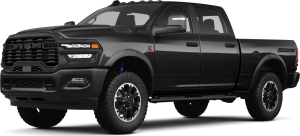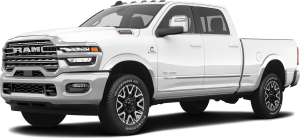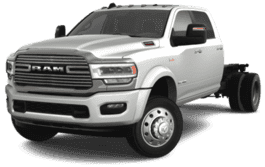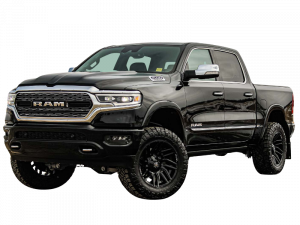
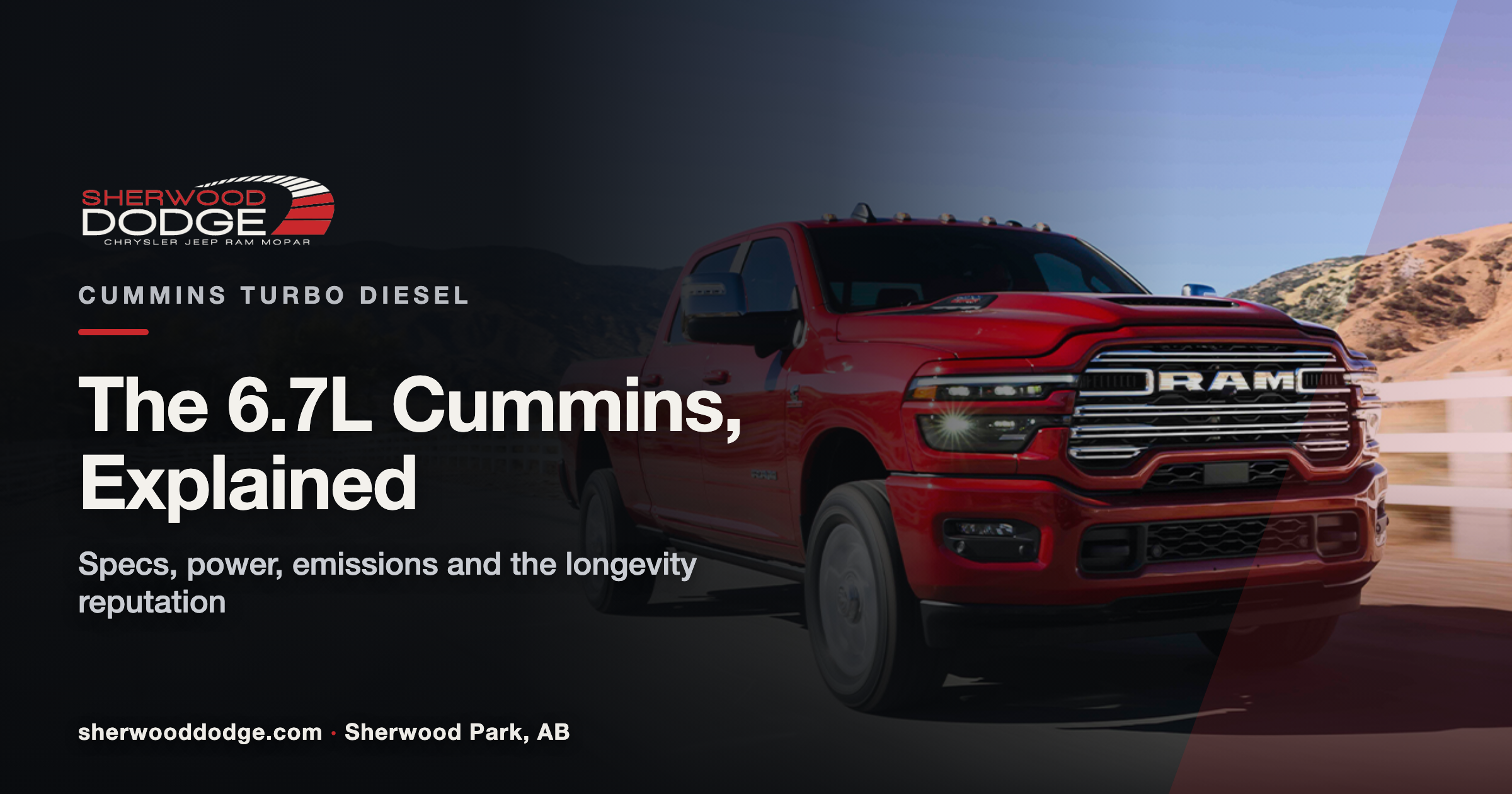
The 6.7L Cummins is the turbocharged inline-six diesel engine RAM offers in its heavy duty pickups, and in current High Output form it makes 430 horsepower and 1,075 lb-ft of torque through a TorqueFlite HD eight-speed automatic transmission (RAM Canada, 2026). It is the engine behind a RAM 2500 rated to tow up to 20,000 lb (9,071 kg) and a RAM 3500 rated to tow up to 36,610 lb (16,606 kg).
Sherwood Park and Fort Saskatchewan buyers ask about this engine more than any other. Every figure below is checked against RAM Canada rather than repeated from a forum.
Key Takeaways
- The 6.7L High Output Cummins Turbo Diesel makes 430 hp and 1,075 lb-ft of torque through a TorqueFlite HD eight-speed automatic (RAM Canada, 2026).
- It powers the RAM 2500 (up to 20,000 lb / 9,071 kg towing) and the RAM 3500 (up to 36,610 lb / 16,606 kg). The 6.4L HEMI gas V8 makes 405 hp / 429 lb-ft (RAM Canada, 2026).
- High Output is the diesel RAM Canada now lists for both trucks. The older standard-output rating of 370 hp / 850 lb-ft belongs to previous-generation trucks (The Autopian, 2024).
- It runs a diesel particulate filter (DPF) and an SCR system using diesel exhaust fluid (DEF). Both are normal, and neither is a reason to avoid a modern diesel (Cummins).
What Is the 6.7L Cummins, and Which RAM Trucks Get It?
The 6.7L Cummins is a 6.7-litre inline-six turbo-diesel built by Cummins and installed in RAM heavy duty pickups, and it is what gives the RAM 2500 and RAM 3500 their towing ceilings (RAM Canada, 2026). It is not a RAM V8 with a diesel badge; it is a purpose-built commercial-grade engine from a manufacturer that has supplied RAM trucks for decades.
Here is where it lands. In the RAM 2500, the diesel is rated for up to 20,000 lb (9,071 kg) of towing versus 17,440 lb (7,910 kg) with the 6.4L HEMI gas V8. In the RAM 3500, it climbs to 36,610 lb (16,606 kg) against the gas V8’s 18,150 lb (8,233 kg). That gap is the whole reason the Cummins exists (RAM Canada, 2026).
RAM has also announced the 6.7-litre Cummins for the Power Wagon at the same 430 hp and 1,075 lb-ft, arriving in the second half of 2026 (DieselNet, 2026).
Browse our new RAM 2500 inventory or see the RAM 3500 lineup to check which trucks on our lot are Cummins-equipped.
Standard Output vs High Output Cummins: What’s the Difference?
The short answer for a new truck: RAM Canada currently lists one diesel for the 2500 and 3500 pickups, the 6.7L High Output Cummins Turbo Diesel at 430 hp and 1,075 lb-ft (RAM Canada, 2026). The SO-versus-HO debate is mostly a used-truck conversation now, because the previous-generation standard-output Cummins was rated at 370 hp and 850 lb-ft before the High Output replaced it (The Autopian, 2024). That matters when cross-shopping used, since “6.7 Cummins” on a listing does not tell you which rating you are looking at.
| Spec | 6.7L High Output Cummins (current) | 6.7L Cummins, standard output (previous generation) |
|---|---|---|
| Horsepower | 430 hp | 370 hp |
| Torque | 1,075 lb-ft | 850 lb-ft |
| Transmission | TorqueFlite HD eight-speed automatic | Six-speed automatic |
| Available on | RAM 2500 and RAM 3500 (new inventory) | Previous-generation RAM 2500 and 3500 (used) |
The practical takeaway: on a new truck you are not choosing between two diesel tunes, you are choosing between the Cummins and the 6.4L HEMI gas V8. We covered that decision in our guide to choosing between the RAM 2500 Cummins and HEMI in Alberta.
Why an Inline-Six Diesel Makes This Much Torque
An inline-six diesel makes big torque because of three things working together: compression ignition, a long piston stroke, and a turbocharger forcing far more air into the cylinders than the engine could draw on its own.
Start with compression. A diesel has no spark plugs. It squeezes air until it is hot enough that injected fuel ignites on contact, and that combustion pushes down on the piston much harder than a gas engine’s does. Then add the stroke: a long-stroke engine gives the connecting rod more leverage on the crankshaft, the same way a longer wrench loosens a stubborn bolt. Force times leverage is torque, and that is the number you feel when a loaded gooseneck starts moving.
The turbocharger ties it together, delivering boost low in the rev range, which is why the Cummins pulls hard at the speeds you actually tow at. Stellantis credits the current engine’s gains to a new turbo, a performance intake manifold, and larger intake and exhaust valves for improved port flow (Stellantis, 2025). The layout helps too: six cylinders in a straight line is inherently well balanced, and a single head over one tall, heavy block is sturdier than two banks of cylinders in a V.
DPF, DEF and Regeneration: The Emissions Hardware Explained
Every modern diesel runs an aftertreatment system that cleans the exhaust after it leaves the engine, and the two parts owners ask about are the diesel particulate filter and the diesel exhaust fluid system (Cummins).
The diesel particulate filter (DPF) traps soot, forcing exhaust through porous walls that capture particulate matter and cut it by more than 90 percent (Cummins).
Regeneration is how the truck cleans that filter out, raising exhaust temperature enough to oxidize the trapped soot and burn it off (Cummins). Most of the time it happens on its own while you drive and you may never notice. What matters is that highway running gives the system the sustained heat it likes, while nothing but short cold trips makes the job harder.
Diesel exhaust fluid (DEF) feeds the SCR system, which handles nitrogen oxides rather than soot. A fine mist of urea is injected into the hot exhaust, converts to ammonia, and reacts with NOx over a catalyst to form harmless nitrogen and water (Cummins). Day to day it is simply a consumable: you top it up, the truck tells you when it is low, and you do not want to run it dry.
If a warning lamp comes on or a regeneration does not seem to be completing, call our service department at (780) 410-4100.
How Long Does a 6.7L Cummins Last? The Longevity Reputation, Honestly
The 6.7L Cummins has one of the strongest longevity reputations of any light-duty-truck engine, and it comes from real design decisions rather than marketing. We are not going to quote you a mileage figure, because the honest answer is that the number depends far more on how a truck was used and maintained than on the badge on the valve cover.
Behind the reputation is a commercial-grade architecture: a heavy iron block and internals built for the sustained cylinder pressures compression ignition creates. Diesels also work at low engine speeds, and fewer revolutions per kilometre means less accumulated wear.
What we see on our own lot matches that. High-kilometre Cummins trucks come through with plenty of life left, and they are almost always the ones with a documented service history: oil and filters on schedule, fuel filters done on time, small problems caught early. The disappointing ones were run hard, serviced late, and driven exclusively on short trips. Buy the engine for its track record, then earn the longevity with maintenance. If you are weighing which truck to put it in, our RAM 2500 versus RAM 3500 comparison covers where each makes sense.
Running a 6.7L Cummins Through an Alberta Winter
Cold-weather diesel operation is completely routine here; it comes down to preparation rather than anything unusual about the engine. Strathcona County owners run these trucks through every winter we get, and the difference between an easy January morning and a frustrating one is usually what was done the night before.
Three habits cover most of it. Plug in the block heater when it is genuinely cold, so the engine starts with warm coolant instead of asking the batteries to do all the work. Use winter-rated, properly treated diesel from a station with good turnover, because untreated summer fuel can gel as temperatures drop. And give the truck a moment to come up to temperature before you load it hard.
Two questions come up every year: whether DEF is a problem in deep cold, and whether winter driving interferes with regeneration. Both have truck-specific answers, so bring them to our service team rather than a forum thread. A Cummins is not a fair-weather engine, but it does reward an owner who plans ahead.
Frequently Asked Questions
How much horsepower and torque does the 6.7L Cummins make?
The 6.7L High Output Cummins Turbo Diesel makes 430 horsepower and 1,075 lb-ft of torque, paired with a TorqueFlite HD eight-speed automatic transmission (RAM Canada, 2026). For comparison, the 6.4L HEMI gas V8 offered in the same trucks makes 405 horsepower and 429 lb-ft.
What is the difference between the standard output and High Output Cummins?
RAM Canada currently lists the High Output version at 430 hp and 1,075 lb-ft for both the RAM 2500 and RAM 3500. The standard-output Cummins is a previous-generation engine rated at 370 hp and 850 lb-ft, so the distinction matters most when shopping used.
What is DEF and does a RAM Cummins need it?
DEF, or diesel exhaust fluid, is a urea solution used by the SCR emissions system. Injected as a fine mist into the hot exhaust, it converts to ammonia and reacts with nitrogen oxides to form harmless nitrogen and water. It is a normal consumable you top up periodically.
How long does a 6.7L Cummins engine last?
There is no single number, because service history and how the truck was used matter more than any figure. The reputation comes from a heavy commercial-grade architecture, an inline-six layout with fewer moving parts, and the low engine speeds diesels operate at. Owners who maintain them on schedule report the longest service life.
Does a Cummins diesel need to be plugged in during an Alberta winter?
Using the block heater in deep cold is standard practice here and makes starts noticeably easier on the engine and the batteries. Pair that with winter-rated, properly treated diesel to avoid gelling, and give the truck a moment to warm up before towing.
See the 6.7L Cummins in Person
The fastest way to understand this engine is to stand beside one, pop the hood, and talk through how you actually use your truck. Browse our RAM 2500 inventory or compare the RAM 3500, then come see us. As one of the largest RAM dealers in Western Canada, we field more Cummins questions than almost anything else, and we can match the configuration to your trailer and your workload.
Sherwood Dodge is at 230 Provincial Ave, Sherwood Park, AB T8H 0E1, serving Sherwood Park, Edmonton, Strathcona County, and Fort Saskatchewan. Call (780) 410-4100 to talk to our sales team about a Cummins-equipped truck, or to reach our service department about your current one.