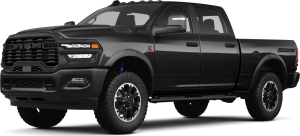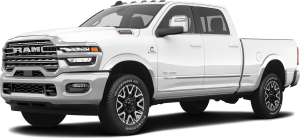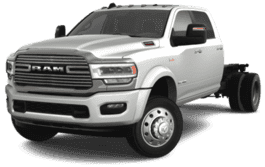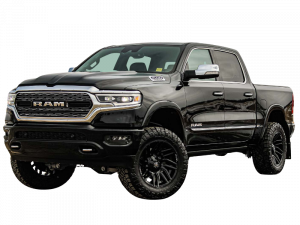
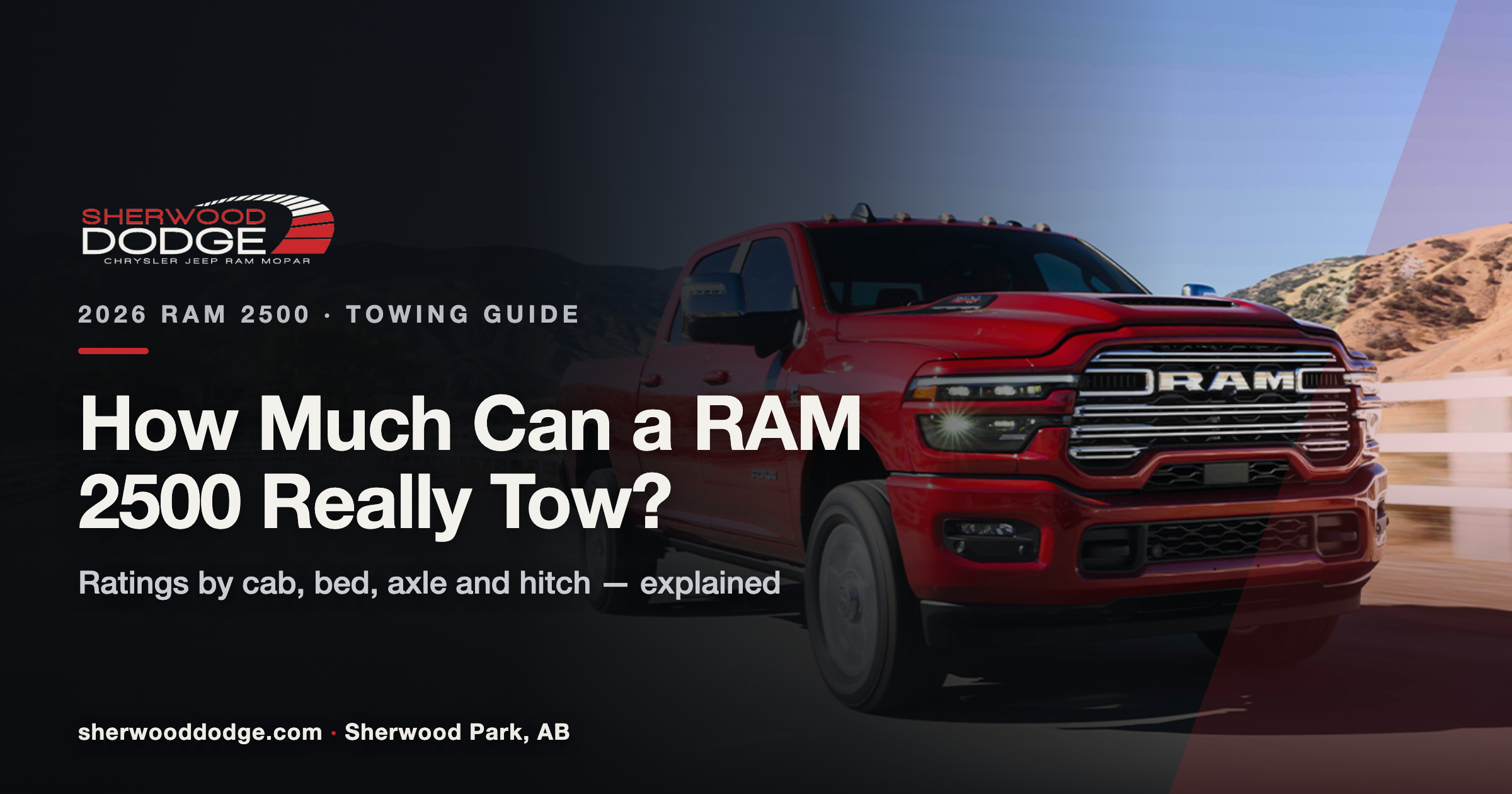
A properly equipped 2026 RAM 2500 tows up to 20,000 lb (9,072 kg) with the High-Output 6.7L Cummins Turbo Diesel, or up to 17,440 lb (7,910 kg) with the 6.4L HEMI V8 (RAM Canada, 2026). Those headline numbers are real, but they belong to two very specific trucks, and almost certainly not to the one in your driveway.
That gap is what this guide is about. Towing capacity on a heavy duty pickup is not one figure attached to the badge, it is the output of a formula: engine, rear axle ratio, cab style, box length, drivetrain and even trim level all move it. Here is how each lever changes the rating, and how to find the honest limit for your own truck.
Key Takeaways
- Maximum towing for the 2026 RAM 2500 is 20,000 lb (9,072 kg) with the High-Output 6.7L Cummins and 17,440 lb (7,910 kg) with the 6.4L HEMI V8 (RAM Canada, 2026).
- That 20,000 lb figure is a 4x2 Crew Cab with the 8-foot box on the 3.42 axle in base trim. Four-wheel-drive diesels top out near 19,930 lb.
- Axle ratio is the biggest single lever on the gas truck. Same Regular Cab, 8-foot box and 4x4: the 3.73 axle rates 15,240 lb, the 4.10 rates 17,440 lb.
- With a gooseneck or fifth-wheel, payload runs out before towing does. RAM calculates pin weight at 15% of gross trailer weight, versus 10% tongue weight conventional.
How Much Can a 2026 RAM 2500 Tow?
The maximum is 20,000 lb (9,072 kg), and reaching it takes one narrow configuration: the High-Output 6.7L Cummins, a Crew Cab with the 8-foot box, the 3.42 rear axle, two-wheel drive and base trim, at a gross combined weight rating (GCWR) of 12,701 kg (28,010 lb) (RAM Canada, 2026). Change any one and the number drops.
Two details in RAM’s fine print matter. The published maximums describe a properly equipped base trim configuration, so the leather and running boards that make a Limited nice to live in all subtract from what it pulls. RAM also lists these as estimated values calculated to the SAE J2807 standard, a test method rather than a promise about your trailer on your road.
Treat 20,000 lb as the top of the model’s range, not your truck’s rating. Browse our new RAM 2500 inventory and we can pull exact ratings by build sheet.
How Cab, Bed and Axle Ratio Change the Rating
Configuration can swing a RAM 2500’s towing capacity by more than 4,500 lb, and the rear axle ratio is the most powerful single lever on the gas truck (RAM Canada, 2026). Heavier cabs cost capacity; the 8-foot box and a numerically higher axle ratio buy it back. Every row below is a real configuration from RAM Canada’s payload and towing guide.
| Engine | Rear axle | Cab and box | Drive | GCWR | Max trailer weight |
|---|---|---|---|---|---|
| 6.4L HEMI V8 | 3.73 | Regular Cab, 8-ft box | 4x4 | 10,002 kg (22,050 lb) | 6,913 kg (15,240 lb) |
| 6.4L HEMI V8 | 4.10 | Regular Cab, 8-ft box | 4x4 | 10,999 kg (24,250 lb) | 7,910 kg (17,440 lb) |
| 6.4L HEMI V8 | 4.10 | Crew Cab, 6-ft 4-in box | 4x4 | 10,999 kg (24,250 lb) | 7,764 kg (17,120 lb) |
| 6.7L Cummins HO | 3.42 | Mega Cab, 6-ft 4-in box | 4x4 | 11,017 kg (24,290 lb) | 6,974 kg (15,380 lb) |
| 6.7L Cummins HO | 3.42 | Crew Cab, 6-ft 4-in box | 4x4 | 12,754 kg (28,110 lb) | 9,019 kg (19,880 lb) |
| 6.7L Cummins HO | 3.42 | Crew Cab, 8-ft box | 4x2 | 12,701 kg (28,010 lb) | 9,072 kg (20,000 lb) |
Read the first two rows again. Identical engine, cab, box and drivetrain; the only difference is the rear axle, and it is worth 2,200 lb of trailer. If you tow, that is the box to get right on the order sheet.
The cab tells the other half. A Mega Cab diesel 4x4 rates 15,380 lb against up to 19,880 lb for a Crew Cab diesel 4x4, because that extra cab is weight the truck carries instead of pulls. Note the drivetrain column too: the 20,000 lb flagship belongs to a 4x2, and adding four-wheel drive settles the diesel ceiling near 19,930 lb.
Conventional Hitch vs Gooseneck and Fifth-Wheel
Switching to a gooseneck or fifth-wheel does not raise a RAM 2500’s maximum trailer weight, it changes where that weight lands on the truck, which is why payload becomes the real constraint (RAM Canada, 2026). RAM calculates tongue weight at 10% of gross trailer weight for a conventional hitch and 15% for a fifth-wheel or gooseneck.
Run that math on a heavy trailer. A 20,000 lb fifth-wheel drops roughly 3,000 lb of pin weight into the bed, plus 250 lb for the hitch hardware itself. Compare that to what a 2500 carries: maximum payload is 4,580 lb (2,078 kg) with the HEMI and 3,590 lb (1,627 kg) with the Cummins, and those are best-case Regular Cab figures. A diesel Mega Cab 4x4 can be as low as 1,790 lb (813 kg). Pin weight, hitch, passengers, fuel and tools all come out of that one budget. The same trailer on a conventional hitch puts about 2,000 lb on the ball instead.
RAM’s guide also sets where a heavier hitch becomes mandatory: a fifth-wheel above 23,000 lb, a gooseneck above 30,000 lb. Both sit above the 2500’s entire range, so a 2500 never needs a fifth-wheel to reach its published rating. The available Fifth-Wheel/Gooseneck Tow Prep Group adds factory mounting provisions and an extra 7-pin bed harness for doing that work properly.
If your loads live at the top of that range, the ceiling is the problem, not the hitch. Our breakdown of the RAM 2500 vs RAM 3500 covers when to move up a class.
Cummins or HEMI: Which Engine Actually Tows More?
The High-Output 6.7L Cummins tows about 2,560 lb more than the 6.4L HEMI V8, but the HEMI carries roughly 990 lb more payload, so the better towing engine depends on whether your load hangs behind the truck or sits in it (RAM Canada, 2026).
The Cummins produces 430 hp and 1,075 lb-ft of torque against the HEMI’s 405 hp and 429 lb-ft. That torque is the whole argument for the diesel: it holds a loaded trailer up a long grade without the transmission hunting, and it is why the ceiling is 20,000 lb versus 17,440 lb.
The trade-off is weight. A Cummins is a heavy engine and every pound comes out of payload, which is why that figure flips: 4,580 lb for the gas truck against 3,590 lb for the diesel. If you haul a slide-in camper, run a service body or carry a heavy fifth-wheel pin, the HEMI can be the more capable truck. For a fuller comparison built around Alberta driving, see our guide to the RAM 2500 Cummins vs HEMI.
How to Find Your RAM 2500’s Real Towing Limit
Your truck’s actual limit comes from three numbers on the vehicle itself, not from a brochure maximum: GVWR, GCWR and the payload figure on the door placard (RAM Canada, 2026).
Open the driver’s door and read the Tire and Loading Information label. It carries the gross vehicle weight rating and, on most trucks, a combined occupant and cargo weight. That payload number already reflects your options, so it beats any published maximum. RAM defines payload as GVWR minus base weight, which is why a loaded Limited has less of it than a stripped Tradesman.
Then work the trailer side. Gross combined weight rating covers truck and trailer together, and on the 2026 RAM 2500 it ranges from 8,165 kg (18,000 lb) on a Power Wagon to 12,754 kg (28,110 lb) on a Crew Cab diesel. Subtract your truck’s scaled weight, loaded the way you actually drive it, and what remains is what you can pull. GVWRs run from 3,885 kg (8,565 lb) to 5,008 kg (11,040 lb) on trucks built with the heavier-rating sales codes.
The step most people skip is the scale. Weigh the truck loaded for a real trip and you have numbers you can trust. Bring those figures in and our RAM 2500 specialists can match them against a specific truck’s build sheet.
Towing a RAM 2500 in Alberta
Alberta towing adds two things no spec sheet covers: cold and grade. Ratings are calculated at a standard, and a January morning in Strathcona County is not that standard.
Cold is mostly a preparation problem. Plug in the block heater, run winter-treated diesel to prevent gelling, and let the truck warm before you load the driveline hard. Give yourself far more stopping distance than the capability figures suggest, because 20,000 lb of trailer on packed snow behaves nothing like 20,000 lb on dry pavement.
Every 2026 RAM 2500 comes with standard Trailer Brake Control, which matters here: under Alberta’s Vehicle Equipment Regulation, a trailer towed by a private passenger vehicle needs its own brakes when its maximum gross weight is over 910 kg and is at least half the unladen weight of the tow vehicle. Check both numbers for your trailer and truck, and if brakes are required, confirm they are wired, adjusted and working before the season starts. Available Trailer Reverse Steering Control and a 360-degree surround-view camera with trailer reverse guidance make the rest easier, and the 2500’s available auto-level rear air suspension earns its keep if you carry heavy pin weight on gravel lease roads.
Frequently Asked Questions
How much can a 2026 RAM 2500 tow?
Up to 20,000 lb (9,072 kg) with the High-Output 6.7L Cummins Turbo Diesel, or up to 17,440 lb (7,910 kg) with the 6.4L HEMI V8 (RAM Canada, 2026). Both figures apply to specific base-trim configurations, so your truck’s rating depends on its cab, box, axle ratio and drivetrain.
Can a RAM 2500 really tow 20,000 lb?
Yes, but only as a 4x2 Crew Cab with the 8-foot box, the High-Output Cummins, the 3.42 rear axle and base trim, at a 28,010 lb gross combined weight rating. Four-wheel-drive diesels top out near 19,930 lb, and a Mega Cab diesel 4x4 rates about 15,380 lb.
Does the Cummins diesel tow more than the HEMI in a RAM 2500?
Yes: up to 20,000 lb versus 17,440 lb, on the strength of 1,075 lb-ft of torque against the HEMI’s 429 lb-ft. The trade-off is payload, where the HEMI carries up to 4,580 lb and the diesel 3,590 lb, because the Cummins is the heavier engine.
Why is my RAM 2500’s towing capacity lower than the advertised maximum?
Because the maximum describes a base trim in the single most favourable configuration. Cab style, box length, axle ratio, four-wheel drive and every option all reduce it. A Mega Cab diesel 4x4 and a Regular Cab diesel 4x2 are both RAM 2500s, and their ratings differ by thousands of pounds.
Do I need trailer brakes to tow with a RAM 2500 in Alberta?
Under Alberta’s Vehicle Equipment Regulation, a trailer towed by a private passenger vehicle needs its own brakes when its maximum gross weight is over 910 kg and is at least half the unladen weight of the tow vehicle. Every 2026 RAM 2500 includes standard Trailer Brake Control.
Bring us your real scaled weights and we will match them to a specific truck’s build sheet instead of a brochure maximum. Visit Sherwood Park Dodge Chrysler Jeep at 230 Provincial Ave, Sherwood Park, AB T8H 0E1, or call (780) 410-4100. We serve Sherwood Park, Edmonton, Strathcona County and Fort Saskatchewan, and you can browse our current RAM 2500 inventory online first. Starting MSRP is published on RAM Canada, but freight, PDI and incentives move weekly, so the out-the-door answer is a quick conversation.