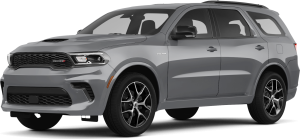
A 2026 Dodge Durango tows up to 3,946 kg (8,700 lb) when properly equipped, either with the GT HEMI V8 and the optional Tow 'N Go package or as the SRT Hellcat (Dodge Canada). The 3.6L V6 trims are rated up to 2,812 kg (6,200 lb), and the GT HEMI Plus and GT HEMI Premium tow up to 3,266 kg (7,200 lb) as standard. The R/T 392 trims, new to Dodge Canada's 2027 lineup, list 3,946 kg (8,700 lb) in their base spec.
Key Takeaways
- The 2026 Durango's top rating is 3,946 kg (8,700 lb), with the GT HEMI V8 plus Tow 'N Go, or the SRT Hellcat (Dodge Canada).
- Without Tow 'N Go, the 2026 GT HEMI trims are rated up to 3,266 kg (7,200 lb). V6 trims top out at 2,812 kg (6,200 lb).
- The 2027 R/T 392 trims seat seven and list 3,946 kg (8,700 lb) as base towing.
- Ratings are for a base configuration. Options, passengers and cargo reduce them.
- For personal (non-business) towing in Alberta, a trailer generally needs its own brakes when its maximum gross weight is over 910 kg and at least half the tow vehicle's unladen weight (Government of Alberta).
How much can each Dodge Durango trim tow?
Base towing on the 2026 Durango runs from 2,812 kg (6,200 lb) on the V6 trims to 3,946 kg (8,700 lb) on the SRT Hellcat Jailbreak, going by the spec rows on Dodge Canada's 2026 models page. The 2027 page adds two R/T 392 trims, also rated at 3,946 kg.
| Trim | Engine | Seats | Base towing | Base payload |
|---|---|---|---|---|
| 2026 SXT | 3.6L V6, 295 hp | 5 | 2,812 kg (6,200 lb) | 658 kg |
| 2026 GT and GT Plus | 3.6L V6, 295 hp | 7 | 2,812 kg (6,200 lb) | 658 kg (GT) |
| 2026 GT HEMI Plus and GT HEMI Premium | 5.7L HEMI V8, 360 hp | 7 | 3,266 kg (7,200 lb) | 612 kg (GT HEMI Plus) |
| 2026 SRT Hellcat Jailbreak | 6.2L, 710 hp | 5 | 3,946 kg (8,700 lb) | 721 kg |
| 2027 R/T 392 Plus and R/T 392 Premium | 475 hp | 7 | 3,946 kg (8,700 lb) | 640 kg |
Source: Dodge Canada's 2026 and 2027 Durango model pages and its Durango capability page. Ratings apply when properly equipped.
Dodge Canada attaches this fine print to its towing and payload ratings: "Max payload/towing ratings shown for base configuration. Additional options, equipment, passengers, and cargo weight may affect payload/towing weights." A Durango with more equipment, or with every seat filled, can end up with less to work with.
Seating belongs in the same conversation, because passengers count against payload. The SXT and SRT Hellcat Jailbreak list five-passenger seating, while the GT, GT Plus, GT HEMI and R/T 392 trims list seven. For the layouts themselves, see our page on Durango seating by trim.
The only 2027 row in the table is the R/T 392, new to Dodge Canada's 2027 lineup. If you're shopping a 2027 SXT, GT or GT HEMI, confirm the 2027 rating for that exact vehicle before you pair it with a trailer.
What does the Tow 'N Go package add?
On a 2026 GT HEMI Plus or GT HEMI Premium, the optional Tow 'N Go package lifts the rating from 3,266 kg (7,200 lb) to 3,946 kg (8,700 lb), when properly equipped (Dodge Canada). Dodge's capability page lists the 3,266 kg figure as standard on both GT HEMI trims.
Dodge Canada puts it this way on its main Durango page: with the available GT HEMI V8 and optional Tow 'N Go package, or the SRT Hellcat model, the Durango offers what Dodge calls a best-in-class towing capacity of up to 3,946 kg (8,700 lb).
That wording describes two routes to the same number. A GT HEMI gets there with the package. The SRT Hellcat gets there as a model, and its spec row on the 2026 models page shows 3,946 kg as base towing with no package named.
If you're buying a GT HEMI to pull something near the top of the range, check that Tow 'N Go is actually on that vehicle. Without it, you're working with 3,266 kg (7,200 lb).
Does more horsepower raise the Durango's towing capacity?
Only up to 3,946 kg (8,700 lb). Dodge Canada lists that same base towing figure for the 710 hp 2026 SRT Hellcat Jailbreak and the 475 hp 2027 R/T 392 trims. The Hellcat's extra horsepower doesn't buy a higher rating.
Below that ceiling, the engine does matter. The 2026 V6 trims (295 hp) stop at 2,812 kg (6,200 lb). The 360 hp 5.7L HEMI needs Tow 'N Go to go past its standard 3,266 kg (7,200 lb), according to Dodge Canada.
So trailer weight won't settle a choice between the R/T 392 and the Hellcat. Seating and payload might. The SRT Hellcat Jailbreak seats five on both the 2026 and 2027 model pages, and the R/T 392 trims seat seven. On payload, the 2026 Hellcat Jailbreak lists 721 kg and the 2027 R/T 392 lists 640 kg. Our R/T 392 versus SRT Hellcat comparison goes through the other differences.
If your trailer is heavier than 3,946 kg (8,700 lb), no 2026 Durango is rated to pull it. Our guide to Ram 1500 towing capacity is worth comparing.
What changed for the 2027 Durango?
Dodge Canada lists eight 2027 Durango models, up from six for 2026, and the two additions are the R/T 392 Plus and R/T 392 Premium. Both make 475 hp, seat seven, and list 3,946 kg (8,700 lb) of base towing with 640 kg of base payload (Dodge Canada).
That's a useful change for families who tow. On the 2026 lineup, the only trim with 3,946 kg in its base spec row is the SRT Hellcat Jailbreak, and it seats five. A seven-seat 2026 Durango gets to the same rating as a GT HEMI with the optional Tow 'N Go package. For 2027, the R/T 392 lists seven seats and 3,946 kg together in its base spec.
For the rest of the 2026 lineup, our 2026 Dodge Durango buyer's guide for Alberta covers each trim. Still deciding between a Jeep and a Dodge? The Grand Cherokee vs Durango comparison puts the two side by side.
Why does payload matter as much as towing capacity?
Payload matters because passengers, cargo and the trailer's tongue weight all come out of one number, and Dodge Canada lists that number per trim: 658 kg for the 2026 SXT and GT, 612 kg for the GT HEMI Plus, 721 kg for the SRT Hellcat Jailbreak, and 640 kg for the 2027 R/T 392 trims.
Tongue weight is the downward load a trailer's coupler puts on the hitch ball. Because it stacks on top of everyone and everything inside, a trailer that sits well under the towing rating can still push a loaded Durango past its payload.
Dodge's own figures show why both numbers deserve a look. The 2026 GT HEMI Plus is rated to tow more than the V6 GT, 3,266 kg (7,200 lb) against 2,812 kg (6,200 lb), yet its listed base payload is lower: 612 kg against 658 kg. Towing rating and payload don't always rise together.
When you compare vehicles in our new Durango inventory, note which options each one has, since Dodge says added equipment can affect payload and towing. Then add up your passengers, your gear and the trailer's tongue weight before the first trip.
Do you need trailer brakes to tow in Alberta?
Alberta's Vehicle Equipment Regulation says that when a private passenger vehicle tows a trailer, the trailer does not need its own brakes if its maximum gross weight is 910 kg or less, or if its maximum gross weight is less than half the towing vehicle's unladen weight (Government of Alberta). Alberta's Traffic Safety Act defines a private passenger vehicle as one used solely for personal transportation, so towing for a business falls under different rules (Government of Alberta). Put the other way round, a trailer generally needs brakes when its maximum gross weight is over 910 kg and at least half the tow vehicle's unladen weight.
The province's towing guide gives the same example: a trailer over 910 kg that is less than half the towing vehicle's weight does not require brakes. Check both numbers for your own trailer and Durango.
Towing also eats into range. The 2026 Durango's fuel tank holds 92 L (Dodge Canada), so plan fuel stops before long highway runs with a trailer behind you.
If your Durango is due for maintenance, book it in with our service department before the season's first long tow. Sherwood Dodge is at 230 Provincial Ave in Sherwood Park, east of Edmonton.
Frequently Asked Questions
How much can a 2026 Dodge Durango tow?
Up to 3,946 kg (8,700 lb) when properly equipped, with the GT HEMI V8 and optional Tow 'N Go package or as the SRT Hellcat (Dodge Canada). The V6 SXT, GT and GT Plus are rated up to 2,812 kg (6,200 lb), and the GT HEMI Plus and GT HEMI Premium tow up to 3,266 kg (7,200 lb) as standard. All are base-configuration ratings.
Do I need Tow 'N Go to reach 3,946 kg (8,700 lb)?
On a 2026 GT HEMI Plus or GT HEMI Premium, yes. Dodge Canada rates those trims up to 3,266 kg (7,200 lb) as standard and up to 3,946 kg (8,700 lb) with the optional Tow 'N Go package. The 2026 SRT Hellcat Jailbreak and the 2027 R/T 392 trims list 3,946 kg (8,700 lb) in their base spec rows.
Does the 2027 R/T 392 tow more than the SRT Hellcat?
No. Dodge Canada lists 3,946 kg (8,700 lb) of base towing for the 2027 R/T 392 Plus and R/T 392 Premium, the same figure the 2026 SRT Hellcat Jailbreak lists. The differences are elsewhere: the R/T 392 makes 475 hp and seats seven, while the Hellcat Jailbreak makes 710 hp and seats five.
How much payload does a Dodge Durango have?
Dodge Canada lists base payload of 658 kg for the 2026 SXT and GT, 612 kg for the GT HEMI Plus and 721 kg for the SRT Hellcat Jailbreak. The 2027 R/T 392 trims list 640 kg. Passengers, cargo and the trailer's tongue weight all count against that figure, and added options can reduce it.
Do I need trailer brakes to tow with a Durango in Alberta?
For personal towing, generally only when the trailer's maximum gross weight is over 910 kg and at least half the Durango's unladen weight. Alberta's Vehicle Equipment Regulation says a trailer towed by a private passenger vehicle needs no brakes if its maximum gross weight is 910 kg or less, or if its maximum gross weight is less than half the towing vehicle's unladen weight (Government of Alberta).
Sources
- 2026 Dodge Durango, Dodge Canada, retrieved October 2026
- Dodge Durango Capability, Dodge Canada, retrieved October 2026
- 2026 Dodge Durango Models, Dodge Canada, retrieved October 2026
- 2027 Dodge Durango Models, Dodge Canada, retrieved October 2026
- Government of Alberta: Vehicle Equipment Regulation, Alta Reg 122/2009, retrieved October 2026
- Government of Alberta: Traffic Safety Act, RSA 2000, c T-6, retrieved October 2026
- Recreational Vehicle Towing Guide (2026 edition), Government of Alberta, retrieved October 2026