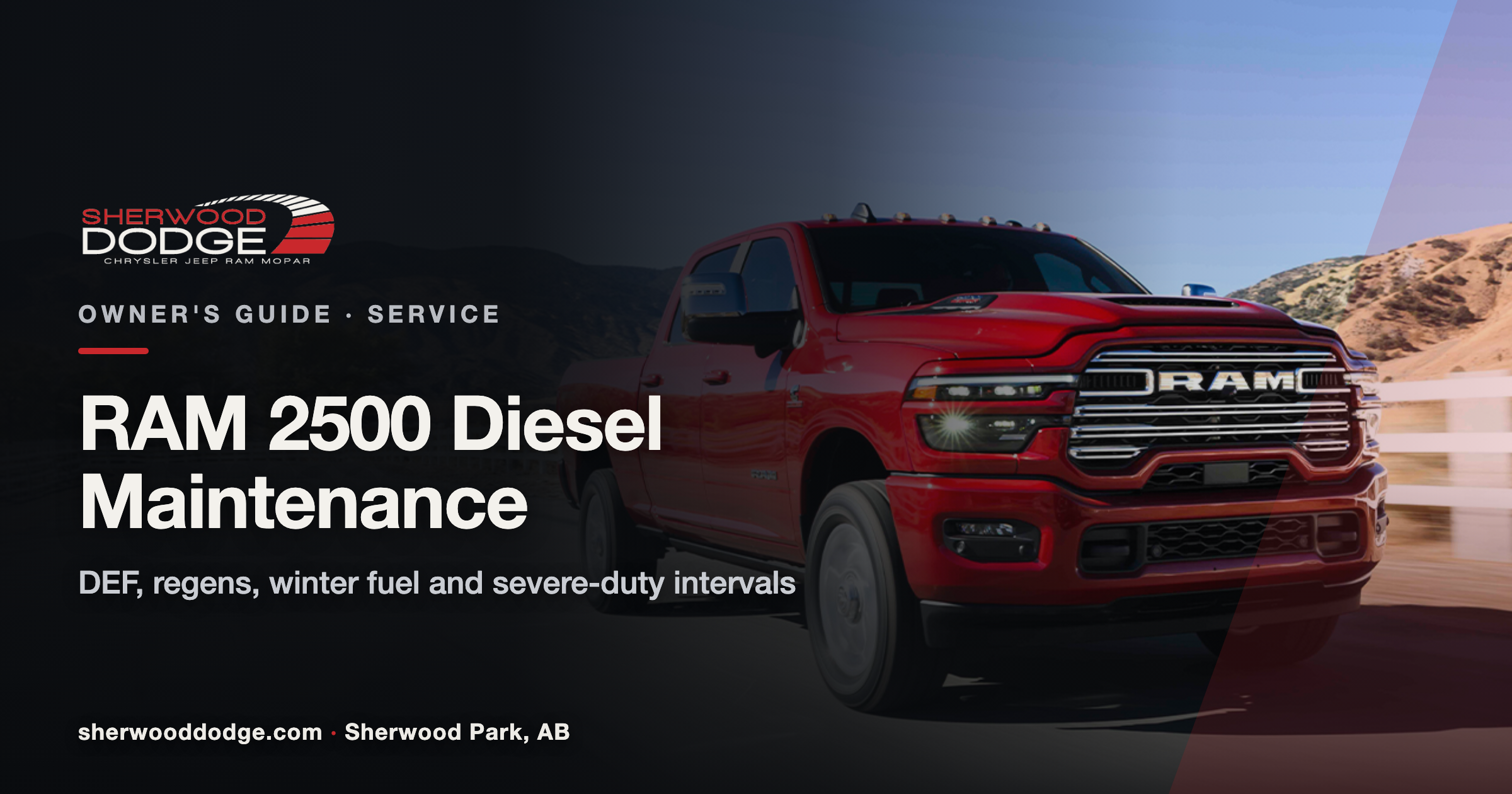
Diesel maintenance on a RAM 2500 comes down to three things a gas truck never asks of you: clean fuel, a healthy emissions system, and service intervals that move with how hard you work the truck. There is no single “change it every X kilometres” answer for a 6.7L Cummins, because the right interval depends on your model year, engine and duty cycle.
That is the manufacturer’s position, not a hedge. Ram Canada publishes a hard ceiling for gas engines, then states plainly that “for diesel engines or vehicles driven under more strenuous conditions, see your Owner’s Manual for exact requirements.” Here is what that means for a truck working out of Strathcona County.
Key Takeaways
- No universal diesel oil interval. Ram Canada’s 16,000 km / 12 month ceiling is published for gas engines; diesel owners are pointed to the owner’s manual and the truck’s oil change indicator (Ram Canada, 2026).
- Severe-duty use shortens intervals. Heavy towing, extended idling, gravel dust and repeated short trips work the truck harder than the baseline schedule assumes.
- The emissions system needs highway time. When the exhaust filter fills, Ram says the cluster asks you to “Safely Drive at Highway Speeds to Remedy”; ignoring it can escalate to a power-reduced message.
- Winter fuel is not optional here. Below about -7°C (20°F), Ram’s guidance calls for climatized Number 2 diesel or a blend to prevent gelling and wax-plugging.
Why Diesel Maintenance Is Different From Gas
A diesel adds a fuel system that will not tolerate water or dirt, plus an emissions system that has to be actively burned clean. Maintenance is about protecting those two systems, not just topping up oil. A Cummins is not harder to own, it simply punishes neglect in different places than a HEMI does.
Diesel injection runs at very high pressure through tight tolerances, which is why Ram’s owner information weights fuel quality and water separation so heavily. The truck has a fuel/water separator, and the guidance is blunt: if the Water in Fuel indicator stays on, “DO NOT START engine before you drain the water from the fuel filter(s).”
Then there is the after-treatment side gas trucks lack entirely: a diesel particulate filter, diesel exhaust fluid, and the electronics managing both. Weighing the two engines? Our Cummins vs HEMI comparison for Alberta owners covers the trade-offs.
Oil, Filters, and the Oil Change Indicator
Your RAM 2500 tells you when it wants oil, and on a diesel that indicator outranks any figure you read online. Ram Canada puts it simply: “when the oil change indicator light on your dash comes on, that’s your reminder that it’s time to come in for scheduled maintenance.”
Here is where owners get tripped up. Ram Canada publishes that “under no circumstances should oil change intervals exceed 16,000 km or 12 months on a gas engine,” and that number gets repeated online as though it covers everything wearing a Ram badge. It does not. That ceiling is stated for gas, and the same page sends diesel owners to the owner’s manual for their exact requirements.
On a diesel, oil service and emissions are linked. Ram warns that “failing to follow the oil change indicator” and running the countdown out “will prevent the diesel exhaust filter from performing its cleaning routine,” which shortly results in a malfunction indicator light.
The Emissions System: DPF Regeneration and DEF in the Cold
Your truck cleans its own exhaust filter, but it needs the right driving conditions to finish the job, and Alberta winters are where that gets interrupted.
The diesel particulate filter traps soot and periodically burns it off in a cycle called regeneration. Ram’s owner information for the 6.7L Cummins says the truck manages this automatically when operating conditions are met, displaying “Exhaust System — Regeneration In Process” while it works. If the filter reaches 80% of its storage capacity, the cluster asks for help with “Exhaust Filter XX% Full Safely Drive at Highway Speeds to Remedy,” noting that “by simply driving your vehicle at highway speeds for as little as 45 minutes, you can remedy the condition.”
That is a cue, not a crisis, but the pattern behind it is common here: short winter trips, long warm-up idles, cold starts that never reach operating temperature. Ignored long enough, Ram escalates to “Exhaust Filter Full — Power Reduced See Dealer,” meaning the engine has been derated to prevent damage.
DEF has its own cold-weather quirk. Ram notes that “in cold conditions, 12°F (-11°C) and below, the DEF gauge needle can stay on a fixed position and may not move for extended periods of time,” and that an electric heater inside the DEF tank “automatically works when necessary.” Consumption is not fixed either: Ram states that altitude, vehicle speed, load and outside temperature all affect it.
Winter Fuel, Gelling, and Fuel Quality in Alberta
Winter fuel is the most important habit on this list. Ram’s guidance is specific: if the vehicle is exposed to extreme cold, described as below 20°F (-7°C), or operates in colder-than-normal conditions for prolonged periods, use climatized Number 2 diesel fuel or dilute the Number 2 with 50% Number 1. The reason is stated just as directly: “this will provide better protection from fuel gelling or wax-plugging of the fuel filters.”
Paraffin wax in untreated summer-grade diesel crystallizes as temperatures drop and plugs the fuel filter, always on the coldest morning of the month. Alberta suppliers move to winter-blended diesel seasonally, so the real risk is summer fuel carried into a cold snap.
On additives, Ram is more conservative than most of the internet: “if you buy good quality fuel and follow the cold weather advice above, fuel conditioners should not be required in your vehicle.” Buy winter-rated fuel, keep the tank reasonably full to limit condensation, and plug in the block heater.
Severe-Duty Conditions That Shorten Your Intervals
Your service interval reflects workload, not the calendar, and trucks around Fort Saskatchewan and Sherwood Park rarely live an easy life. Ram Canada makes the principle explicit on the gas side, shortening the interval to 6,500 km for conditions like excessive idling or dusty and off-road driving, then directing diesel owners to the manual. The table below stays qualitative because the real intervals belong to your model year’s manual.
| Maintenance item | What it is protecting | What shortens the interval |
|---|---|---|
| Engine oil and filter | Bearings, turbo and the emissions cleaning cycle | Heavy towing, extended idling, short trips, deep cold, dusty air |
| Fuel filters and water separator | High-pressure injection system | Off-season or poor-quality fuel, water in fuel, high annual mileage |
| Air filter | Turbo and combustion | Gravel roads, lease-site dust, grain dust, construction sites |
| DEF level | Emissions compliance and normal operation | Heavy loads, sustained highway towing, temperature extremes |
| DPF regeneration | Exhaust filter and engine power | Short trips, long idles, low-speed in-town running |
| Cooling system and belts | Engine under sustained load | Sustained grades under load, summer towing, winter cold cycling |
Four patterns matter most: towing near the truck’s limits, extended idling that builds soot without the heat to clear it, gravel roads that pack the air filter, and short winter trips that never let the truck complete a regeneration. Living in more than one of those columns? Assume the severe schedule. Our RAM 2500 vs RAM 3500 comparison covers where the capability ceilings sit.
Warning Messages That Mean “Book Service Now”
Most diesel messages are informational, but a few mean stop guessing and get in. Treat these as book-an-appointment messages:
- “Exhaust Filter Full — Power Reduced See Dealer.” Ram describes the engine as derated to prevent permanent damage, warning that “damage to the exhaust system could occur soon with continued operation.”
- Water in Fuel indicator staying on. Ram is explicit: do not start the engine before the water is drained.
- A malfunction indicator light after a missed oil change. Often the emissions system reporting it could not finish its cleaning routine.
- A low-DEF warning that keeps escalating. DEF is required for normal operation, so a warning that will not clear needs diagnosis.
- Hard starting or a stumble in deep cold. Frequently fuel-related.
The regeneration-in-progress and regeneration-completed notices mean keep driving normally. Our service department can read the codes and confirm whether you sit on the standard or severe-duty interval.
Getting Your RAM 2500 on the Right Schedule
Match the schedule to real workload, trust the oil change indicator and your owner’s manual over any number you read online, buy winter fuel, and treat emissions messages as instructions. Unsure which schedule you are on? That is a short conversation with a technician who can look at your model year, your mileage and how the truck actually gets used.
Frequently Asked Questions
What is DEF and why does my RAM 2500 need it?
Diesel exhaust fluid is a consumable the truck uses to keep its emissions system working, and it is required for normal vehicle operation. How much you use is not fixed: Ram notes that altitude, vehicle speed, load and outside temperature all affect DEF consumption, so towing heavy and running in temperature extremes increases it.
What is a diesel regen, and what should I do when the message appears?
Regeneration is the truck burning accumulated soot out of its exhaust filter, and it normally happens automatically. If the cluster shows an “Exhaust Filter XX% Full Safely Drive at Highway Speeds to Remedy” message, Ram’s owner information advises that driving at highway speeds for as little as 45 minutes can clear the condition. If it escalates to a power-reduced message telling you to see a dealer, book service instead of driving it out.
Does a RAM 2500 diesel need a block heater in Alberta?
The engine block heater warms the engine so it starts more easily in cold weather, and plugging in is standard practice for Alberta diesel owners through winter. Combined with winter-rated fuel, it is the difference between an easy morning and a hard one. Confirm what is fitted to your truck and trim.
How often should I service my RAM 2500 Cummins?
There is no single answer, and any source giving one number for every diesel is guessing. Ram Canada publishes a 16,000 km or 12 month ceiling for gas engines and directs diesel owners to their owner’s manual for exact requirements. Follow the manual and the oil change indicator, and have the service department confirm whether your usage puts you on the severe-duty schedule.
What happens if I use summer diesel in an Alberta winter?
Untreated summer-grade diesel can gel in deep cold, where wax crystals plug the fuel filters and the truck becomes hard or impossible to start. Ram’s guidance is to use climatized Number 2 diesel or dilute Number 2 with 50% Number 1 when the vehicle is exposed to conditions below 20°F (-7°C), specifically to protect against gelling and wax-plugging. Ram adds that with good fuel, conditioners should not be required.
Ready to get your truck looked at? Book a service appointment with Sherwood Park Dodge Chrysler Jeep, 230 Provincial Ave, Sherwood Park, AB T8H 0E1, or call (780) 410-4100. We service RAM diesels across Sherwood Park, Edmonton, Strathcona County and Fort Saskatchewan, and you can browse our new RAM 2500 inventory while you are here.