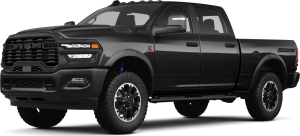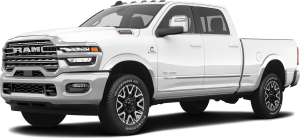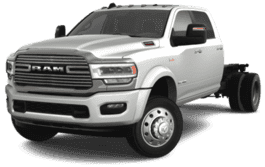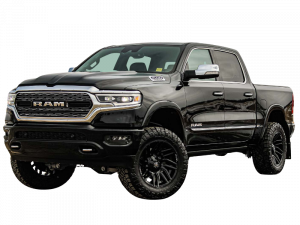
Yes, your 4x4 RAM still needs winter tires. Four-wheel drive helps you go; winter tires help you stop and steer, which is where Alberta winters punish trucks. Transport Canada is direct about why: “At temperatures below 7 °C, all-season and summer tires begin to lose elasticity, leading to less traction. Winter tires keep their elasticity and grip at much lower temperatures” (Transport Canada, 2024). No drivetrain compensates for rubber that has gone hard.
We made that argument in our guide to the best truck for Alberta winters. This is the practical follow-up: reading size and load range off your own door placard, what the snowflake symbol certifies, second wheels versus swapping rims, sensors, and when to book.
Key Takeaways
- Below 7 °C, all-season rubber stiffens and loses grip while winter compounds stay pliable. That threshold arrives here long before the first snowfall (Transport Canada, 2024).
- Alberta does not legally require winter tires. Quebec does, and British Columbia requires them on designated highways.
- On a RAM 2500 or 3500, load range matters as much as tire size. A tire matching the size but not the placard’s load capacity lowers what the truck can safely carry.
- Look for the three-peak mountain snowflake (3PMSF) symbol, and buy four. Transport Canada recommends sets of 4.
Does a 4x4 RAM Really Need Winter Tires?
More than a car does, not less. A pickup carries serious mass and, with an empty box, carries very little of it over the rear wheels. Mass is what has to be stopped, and the only things stopping it are four contact patches the size of your hand. Four-wheel drive adds traction on the throttle and does nothing on the brake pedal.
That mismatch plays out in our service bay every January. A 4x4 RAM on worn all-seasons will out-accelerate almost anything from an icy light on Wye Road, then arrive at the next intersection carrying more speed than the driver expected. Heavy-duty trucks add a wrinkle: built for payload, they run stiffer, higher-capacity tires, and a stiff casing on a glazed road gives up grip faster than a softer one. Choosing between a three-quarter-ton and a one-ton? Our RAM 2500 vs RAM 3500 comparison covers how those ratings differ.
The 7 °C Rule: What the Rubber Actually Does
The 7 °C figure is a material property, not a marketing number. Below roughly 7 °C, all-season rubber stiffens, the tread stops conforming to the road surface, and grip falls away before any snow hits the ground (Transport Canada, 2024). Winter compounds stay soft well past that, which is why they still work at −30 °C. The thermometer beats the calendar as a trigger: mornings here dip under 7 °C well before anyone calls it winter.
Cold also takes air out of your tires. Transport Canada notes they lose “about 7 kPa or 1 psi for every 5 °C drop in temperature” (Transport Canada, 2024), and warns that “a tire that has good pressure when checked in a warm garage will be under-inflated when it’s below zero outside” (Transport Canada, 2024). On a heavy truck, running soft is not minor. Check pressures cold, monthly. On many newer RAM trucks you can also set the tire fill alert so the truck tells you when you have reached the target pressure.
Read Your Door Placard First: Size and Load Range
Before you shop, open the driver’s door and find the tire information label. Transport Canada confirms it is usually on the door edge, the door post, the glove box, or the fuel door (Transport Canada, 2024). It lists the original tire size and the recommended cold inflation pressures, which are not always the same front and rear on a heavy-duty truck.
Here is the part that matters enormously on a 2500 or 3500 and barely registers on a car. Alongside the size, tires carry a load index, and light-truck tires carry a load range letter: how much pressure the casing is built to hold, and therefore how much weight the tire can safely carry. Higher load range, stronger casing, more capacity. Two tires can share an identical size marking and still be built for very different jobs.
Transport Canada is unambiguous: “New tires should be the same size, and have the same load capacity and speed rating as the original tires,” and you should “install the same type of tire on all wheel positions” (Transport Canada, 2024). Dropping below the load range your placard specifies lowers what the truck can legitimately haul or tow. If you pull a fifth wheel or run near your payload, this is the most important number in the purchase.
We are not printing sizes here, because RAM fitments vary by trim and wheel package. Read your placard, then call our parts and service team with the size and load rating in hand.
3PMSF vs All-Season vs All-Weather
The sidewall marking tells you what a tire has been tested to do. Transport Canada describes the three-peak mountain snowflake plainly: tires carrying it “meet specific snow traction performance requirements and have been designed specifically for use in severe snow conditions” (Transport Canada, 2024). The symbol was created by the Tire and Rubber Association of Canada with the U.S. Tire Manufacturers Association, and it is the standard Quebec’s winter tire law recognizes (TRAC, 2024).
| Tire type | Sidewall marking | Best for | The tradeoff |
|---|---|---|---|
| Dedicated winter | 3PMSF (plus M+S) | −30 °C cold snaps, ice, unplowed rural roads | Swapped seasonally; wears fast if left on into summer |
| All-weather | 3PMSF (plus M+S) | One-set convenience for mostly-city drivers | Severe-snow rated, but gives up bite in deep cold |
| All-season | M+S only | Three seasons, warm and wet pavement | Not severe-snow rated; stiffens below 7 °C |
| Studded winter | 3PMSF, studs fitted | Glare ice, steep icy approaches | Noisy on bare pavement; seasonally restricted in places |
For Sherwood Park and Fort Saskatchewan drivers who commute on plowed roads, a good all-weather set is legitimate and far better than any all-season. If you park on an acreage, run gravel, or tow through the season, dedicated winters still win. Either way, buy four: mismatched grip front to rear is harder to control than less grip everywhere.
Second Set of Wheels, or Swap on the Same Rims?
If you plan to keep the truck more than a couple of seasons, a second set of wheels is usually the better call. With tires already mounted on their own rims, the changeover becomes a wheel swap instead of a tire job: quicker, easier to book, and it avoids breaking the bead on your good rims twice a year, plus it spares them a season of road salt and gravel chips. Swapping onto existing rims costs less up front, but you pay to mount and balance twice a year, every year.
Then there is the sensor question. Transport Canada describes two kinds of tire pressure monitoring system: one that “uses ABS sensors to measure the rotational speeds of the wheels,” and one that “directly measures the pressure with a wheel mounted pressure sensor in each wheel” (Transport Canada, 2024). With the indirect kind, a second set of wheels needs no new hardware. With the direct kind, every winter wheel needs its own sensor, or the warning light stays on all season. That is a per-VIN question, so have our parts department check before you order wheels.
When to Book, and How Storage Works
Book earlier than feels necessary. Late September through October is the busiest stretch of the year for tire work across Sherwood Park, Edmonton, and Strathcona County, and the pattern repeats: a mild fall lulls everyone into waiting, the first snowfall lands, and every service drive books solid within days. Ordering early matters too, because heavy-duty sizes and higher load ranges are lower-volume, so the fitment a 2500 or 3500 needs goes scarce first.
Storage is simpler than people expect. Tires last longest kept clean, dry, and out of direct sunlight. Mark each one with the position it came off so they can be rotated correctly next season. If you would rather not give up the garage space for eight months, ask our parts department whether seasonal tire storage is available.
Frequently Asked Questions
Are winter tires required by law in Alberta?
No. Alberta does not legally require winter tires. The province recommends them, noting that “winter or snow tires are specially designed for the low temperatures and snowy and icy conditions we experience in Alberta” (Government of Alberta, 2024), but there is no mandate. Two caveats: drivers must still drive according to road conditions, and if you head west, British Columbia requires winter tires on designated highways while Quebec mandates them from December 1 to March 15.
Does 4x4 mean I can skip winter tires on my RAM?
No. Four-wheel drive helps you accelerate; it does nothing for braking or cornering grip. Below 7 °C, all-season rubber loses elasticity and traction while winter compounds stay pliable (Transport Canada, 2024). A 4x4 RAM on all-seasons will pull away from a winter-tired truck at a green light, then need more room to stop at the next one.
Do I need new TPMS sensors for a second set of winter wheels?
It depends which system your truck has. Transport Canada describes indirect systems that read wheel speed through the ABS sensors, and direct systems that use a pressure sensor in each wheel (Transport Canada, 2024). Indirect needs no extra hardware; direct needs a sensor in every winter wheel, or the dash warning stays lit all season. Have our parts department confirm which one your truck uses.
When should I book my winter tire changeover in Sherwood Park?
Aim for September. Late September through October is the peak changeover window across the Edmonton area, and appointments disappear within days of the first snowfall. Booking early also leaves time to order the right size and load range for a 2500 or 3500, since heavy-duty fitments go scarce fast.
Can I run all-weather tires on my RAM instead of dedicated winters?
You can, and for many city commuters it is a reasonable single-set compromise. All-weather tires carry the same three-peak mountain snowflake symbol, so they are certified for severe snow service. They just give up some deep-cold bite. If you drive gravel, park on an acreage, or tow through winter, dedicated winters remain the better tool.
Rather have someone read the placard with you? Bring the truck by. Our parts and service team can confirm the correct size and load range for your RAM, tell you whether it needs winter-wheel sensors, and get you booked before the fall rush. Sherwood Park Dodge Chrysler Jeep is at 230 Provincial Ave, Sherwood Park, AB T8H 0E1. Call (780) 410-4100 or book a service appointment online. We serve Sherwood Park, Edmonton, Strathcona County, and Fort Saskatchewan. Shopping for the truck first? Browse our RAM inventory.